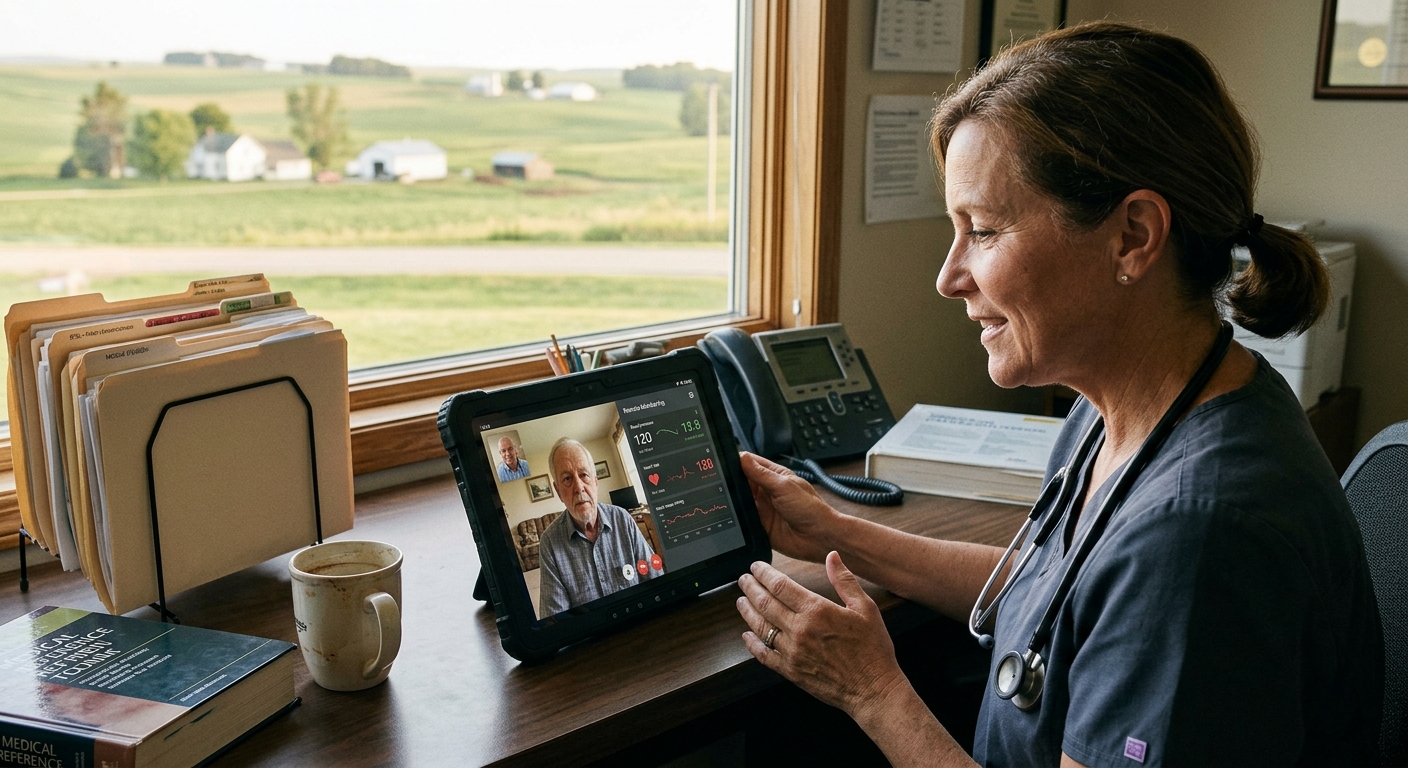
What AI Could Mean for Rural and Underserved Care Between Visits
The opportunity is not to replace scarce clinicians. It is to extend useful support into the parts of daily life where a care team cannot always be present.
A patient can leave a clinic with a thoughtful care plan and still face hundreds of decisions before the next appointment. What should I eat tonight? I have not slept well for three nights, does that matter? My routine fell apart this week. Is this just a bad week, or is something beginning to change? The restaurant nearby does not publish nutrition information, and I have very few other options. What is a reasonable choice?
For people managing metabolic conditions, chronic disease, or a new medication routine, these are not unusual questions. They are everyday questions, and many of them happen far away from the clinical encounter where the treatment plan was created.
That gap exists everywhere, but it becomes especially visible in rural and medically underserved communities, where access itself can be harder. Roughly one in five Americans lives in a rural area, and rural communities often contend with fewer healthcare workers, fewer specialists, longer travel distances and more limited infrastructure than their urban counterparts.
It is tempting to look at those shortages and jump immediately to AI. Not enough specialists? Use AI. Long travel distances? Use AI. Overloaded clinicians? Use AI.
But that skips the more useful question.
AI cannot manufacture a dietitian in a county that does not have one. It cannot create transportation, build broadband infrastructure, reopen a hospital, or reproduce the trust a patient may have developed with a local clinician or community health worker.
We should also be careful not to assume the evidence is further along than it is. A recent Journal of the American Medical Informatics Association review found relatively little U.S. research examining AI specifically in rural healthcare settings, and even less evidence of systems being deployed and evaluated in real-world rural environments.
That does not make rural health a bad place for AI. It makes it a place where we should be much more specific about the job we want AI to do.
The opportunity I find most interesting is not creating an artificial clinician. It is extending useful support into the enormous amount of time when the clinician simply cannot be there.
Telehealth already helped healthcare cross one important boundary: the patient and clinician no longer always need to occupy the same room. Research in areas such as rural diabetes care suggests remote-care models can be useful, while also exposing familiar limitations around connectivity, usability, infrastructure, workload and the continued importance of in-person care.
But even telehealth still requires someone on the other end of the call.
There are still thousands of hours when nobody is.
That is the space we spend a lot of time thinking about at DrunR.
Healthcare tends to see a patient at particular moments: an appointment, a lab result, a prescription, a message, perhaps a remote measurement. The patient experiences everything in between. Meals. Movement. Sleep. Symptoms. Stress. Medication routines. Work. Travel. Family. The food actually available that evening. The good weeks, and the weeks when the plan slowly starts slipping.
Most of those moments should probably never become another notification in a clinician's inbox. More data is not automatically more care. But some of that information may eventually become useful context if we can understand it, compress it and determine what actually matters.
That distinction is important.
Imagine technology that does not try to turn every daily event into a medical event. Instead, it helps a person understand a reasonable next action within goals already established with their care team. It recognizes when information is incomplete. It understands that a missing signal is actually missing. And over time, it may help organize patterns so that when the next clinical conversation happens, the patient and provider begin with something more useful than, “How have things been since I last saw you?”
Once we think about the problem this way, another challenge becomes obvious: if this type of technology is supposed to expand access, it cannot depend on perfect data.
We cannot design only for the person with a new smartphone, reliable broadband, a premium wearable, continuous glucose data, complete EHR connectivity and enough time to record everything they eat. A system built around that person might produce impressive personalization while quietly excluding many of the people we say we want technology to help.
The alternative is to design for imperfection from the beginning. If a wearable is available, use its signals where appropriate. If it is not, the system should still work. If sleep information is missing, the system should not quietly invent certainty. If the available information is limited, confidence should change with it.
Personalization should degrade gracefully when the data does.
The same principle applies to food.
A nutrition product designed in a dense urban market can easily assume that people have hundreds of restaurants nearby, national chains with standardized nutrition information, specialty grocery stores and an abundance of alternatives. That is not everyone's reality.
A smaller community may depend more heavily on independent restaurants, a limited number of grocery stores, convenience stores, regional food businesses and home-prepared meals. Geography itself changes what “choice” means. The theoretically better option may simply not exist nearby.
So the useful question may not always be, “What is the healthiest possible meal?”
It may be, “Given what is actually available to this person, in this place, right now, what is a reasonable next choice?”
That sounds like a small shift, but it changes the philosophy of the system. Instead of judging someone against an ideal environment, the technology begins with the environment they actually live in.
That is especially important if AI is going to play a role.
A system supporting everyday health decisions should know what information it has, what it does not have and how much confidence to place in its own conclusion. It should preserve where information came from. It should distinguish a behavioral suggestion from a medical determination. And when a question belongs with a healthcare professional, good design should make that boundary clearer rather than hiding it behind fluent, confident language.
Those ideas are influencing how we are building DrunR.
Our direction is to understand a person's current context before generating guidance: what signals are available, what is missing, what recently changed, what their goals are, what environment they are making a decision in and how confident the system should be in what it knows.
We are starting with GLP-1 and metabolic care, including one of the most ordinary but difficult parts of that experience: making food and behavioral decisions in real life. The longer-term question is whether that same state-first approach can help turn fragmented daily-life information into useful support for the patient and eventually more structured context for the care team.
That is a technical direction we are building and testing, not a claim of clinical effectiveness.
Rural expansion presents an even bigger learning challenge because rural communities are not simply smaller versions of urban markets. A farming community, a Tribal community, an Appalachian town and a remote community in Alaska may have entirely different infrastructure, food access, culture, clinical resources and definitions of what useful support looks like. Any meaningful solution has to be shaped with the people who live and work there rather than designed remotely and delivered as a finished answer.
And that may point to a broader lesson for health AI.
Perhaps the future is not a choice between human care and artificial intelligence. Perhaps the more useful role for AI is to help human care travel farther: to help a patient make a reasonable decision when no clinician can be present, to help a care plan survive contact with daily life, to recognize meaningful change without turning every change into an alert, and to organize what happened between visits so that the next human conversation has better context.
For that to work, the technology also has to know its limits. Someone without a wearable should not automatically be excluded. Missing information should reduce confidence rather than create false precision. And when the system does not know enough, saying so should be part of the product rather than treated as a failure.
That version of health AI is quieter than the autonomous-doctor future we often hear about, but I think it may be far more useful.
It does not try to replace the people providing care.
It tries to make care a little less episodic, so that some of the support created during a clinical visit can reach further into the thousands of hours when patients are otherwise left to navigate everyday decisions on their own.