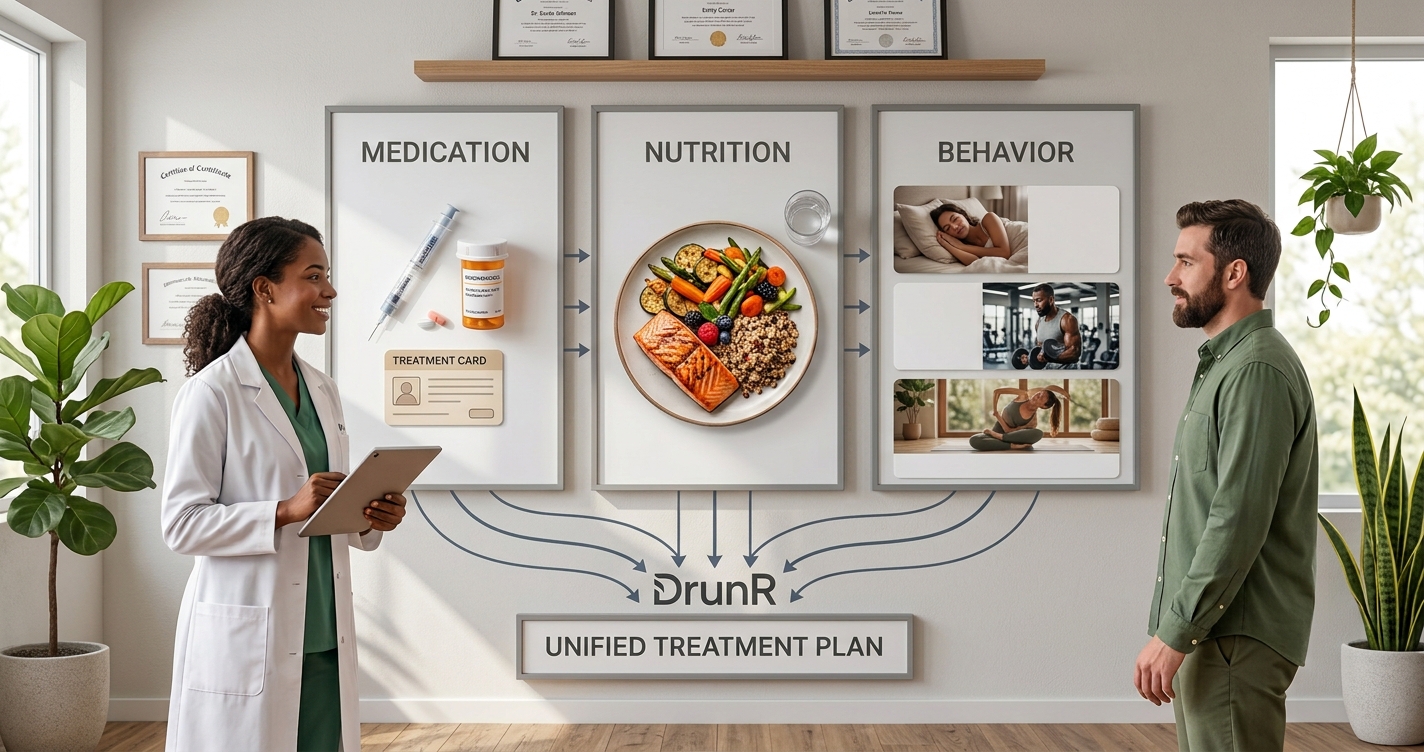
There is a strange mismatch developing in healthcare. Patients are increasingly asking for help with nutrition, activity, sleep and the everyday behaviors that affect their health. Clinical guidelines are also becoming clearer that, for many metabolic conditions, medication is only one part of the treatment plan.
But the person writing that treatment plan may have 15 or 20 minutes with the patient, limited access to a dietitian, and relatively little formal training in how to translate nutrition science into hundreds of decisions someone will make after leaving the clinic.
That is not a physician failure. It is a system problem.
A 2024 review in Advances in Nutrition looked back at four decades of physician nutrition education and concluded that progress has remained limited. Most medical schools still do not meet the long-standing recommendation for at least 25 hours of nutrition education, and the authors describe similar gaps during residency and specialty training. They also point to time, reimbursement, limited dietitian access and training requirements as structural barriers once physicians enter practice. (PubMed Central (PMC))
At the same time, people seem to want more of this support, not less. A national U.S. survey on “Food is Medicine” found that fewer than half of respondents said they received clear food and nutrition advice from their primary-care providers, while a majority were interested in participating in Food is Medicine interventions. More than two-thirds supported Medicare and Medicaid coverage for these types of programs. (PubMed)
So we have demand on one side and a capacity problem on the other. And the clinical science makes that gap harder to ignore.
For people with type 2 diabetes and overweight or obesity, the American Diabetes Association’s 2026 Standards of Care recommend nutrition, physical activity and behavioral therapy as part of treatment. The ADA goes further: when access to intensive counseling is limited, it specifically says structured alternatives such as remote programs, telehealth and mobile apps may be considered. (Diabetes Journals)
GLP-1 care makes the issue even more visible. A 2025 joint advisory from the American College of Lifestyle Medicine, American Society for Nutrition, Obesity Medicine Association and The Obesity Society says evidence-based nutrition and lifestyle support plays a pivotal role alongside GLP-1 therapy. The advisory discusses issues including GI symptoms, reduced food intake, nutrient adequacy, preservation of muscle and bone, physical activity, sleep and longer-term behavior support. It also specifically identifies dietitian counseling, telehealth and digital platforms as potential ways of extending that support. (PubMed)
And this is not only an obesity or GLP-1 issue. European guidelines for metabolic dysfunction-associated steatotic liver disease, or MASLD, advise lifestyle modification including dietary change, physical activity and weight management alongside appropriate treatment of metabolic conditions and medication where indicated. (PubMed)
The common thread is pretty simple:
The medication may happen once a day or once a week. The treatment plan has to survive the rest of the day.
That is where I think healthcare still has an unfinished problem.
A clinician can establish the goals. A dietitian can provide specialized nutrition therapy. But then the patient leaves.
Dinner happens at a restaurant. Sleep changes. Activity changes. Appetite changes. A medication dose changes. Someone feels nauseated for two days. They miss lunch. They travel. They exercise more than usual. They have incomplete nutrition information and have to make a decision anyway. Then several weeks later we ask, “How have things been?”
That period is what we call the invisible middle at DrunR: the time between clinical visits where the treatment plan meets real life. Our goal is not to turn an AI model into a doctor. It is to help make that period more understandable and help patients make everyday decisions that remain aligned with the direction their care team has established.
Trust has to be designed into the system
This is also where health AI can go wrong very quickly. The easy technical approach was to collect a lot of patient data, send it to a large language model and ask, “What should this person do?”
That is not the architecture we are building.
DrunR first separates what is known about the food from what is known about the person. Its State Engine then builds a time-sensitive, confidence-scored representation of the available context. Missing information stays Unknown rather than quietly becoming “normal,” and confidence determines how strongly a signal is allowed to influence an output.
Then come the guardrails.
Provider-defined restrictions and safety rules take precedence over ranking. Allergies and exclusions are handled before recommendations are considered. Certain symptom patterns cause the system to abstain from food optimization and direct the person toward appropriate healthcare guidance instead. The language model can help explain a structured result, but it is explicitly not allowed to invent nutrition facts, clinical state, treatment targets or its own medical rationale.
We are also deliberately not assuming that one condition model transfers to another. A nutrition priority that makes sense for one person could be inappropriate for someone with kidney disease, heart failure, cancer treatment or another clinical context. DrunR’s architecture therefore requires separate condition-specific evidence, safety rules, provider targets and validation before those areas can be supported. Those additional condition modules are not currently implemented.
And every decision is intended to leave a trace: what information was used, what was missing, the confidence behind the state, which rules were applied, the relevant evidence references and which version of the model produced the result. That still does not make DrunR clinically validated today. Our current State Engine is a prototype, and its internal parameters require calibration, clinical review and validation before stronger clinical claims can be made.
But I think this is the right standard to build toward. We should not ask physicians to trust another black-box AI assistant. We should build tools that know their boundaries, show their evidence, respect the care team's rules, admit when information is missing and help carry a treatment plan into the thousands of ordinary decisions that happen after the appointment is over.
Because the real opportunity is not replacing the visit. It is finally building a bridge between one visit and the next.