End Users
The K-Shaped Healthcare Divide
September 14, 2026
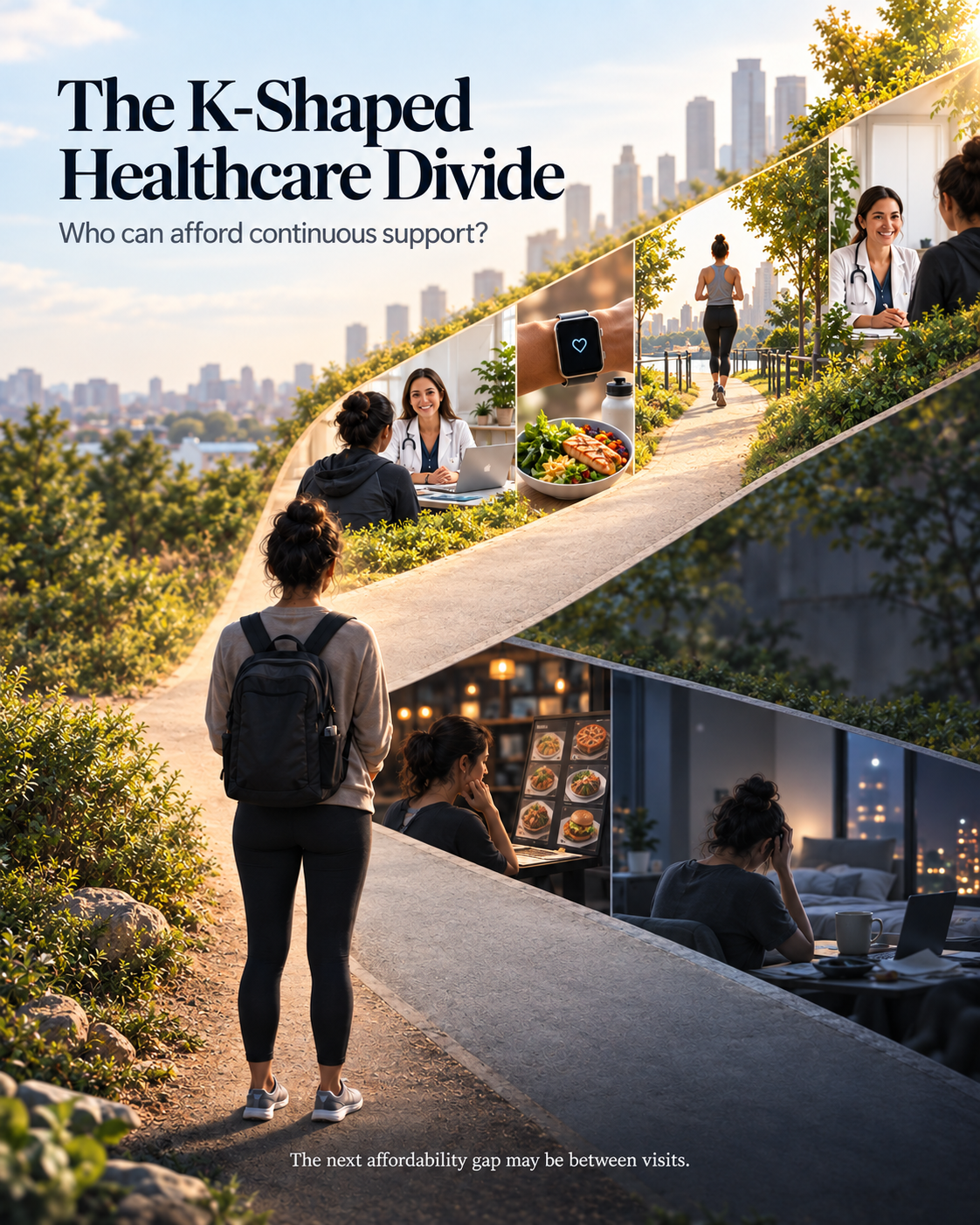
Healthcare is becoming K-shaped.
Not the Wall Street version.
One side of the K has access to more than treatment.
They can afford the layers around it: dietitians, coaches, frequent follow-ups, wearables, personalized nutrition support, fitness guidance, and someone to help interpret what is happening when things change.
The other side may receive a treatment plan, and then spend most of the time figuring out the rest alone.
What should I eat today?
Should I exercise or recover?
Why do I feel different this week?
How do I make this plan work in a restaurant, at work, while traveling, or on a bad day?
These look like small decisions.
But healthcare happens through thousands of small decisions between appointments.
And I don't think the answer is simply asking care teams to do more.
Doctors, nurses and dietitians want to support their patients. But there are only so many hours in a day. A care team cannot sit beside every patient at breakfast, at the gym, inside a restaurant, or at 9 PM when something doesn't feel right.
That creates a different kind of healthcare affordability gap:
Who can afford continuous support, and who is left to figure it out?
This is one of the problems we're thinking deeply about at DrunR.
Food intelligence is part of it, but it isn't the center.
Patient state is.
Can we bring together signals that look unrelated, nutrition, activity, medication context, sleep, body signals, recent behavior and the environment around someone, to better understand what may be happening now, before providing guidance for the next decision?
We're starting with restaurants because they represent one of the hardest real-world environments. Nutrition has been a black box for a long time, particularly outside large chains and for smaller food businesses.
But the larger mission goes beyond restaurants.
It is about making the support between healthcare visits more accessible, so continuous guidance doesn't become another advantage available mainly to people who can afford a human team around them.
The next healthcare affordability divide may not just be who can afford treatment.
It may be who can afford help living with it every day.
Share this blog