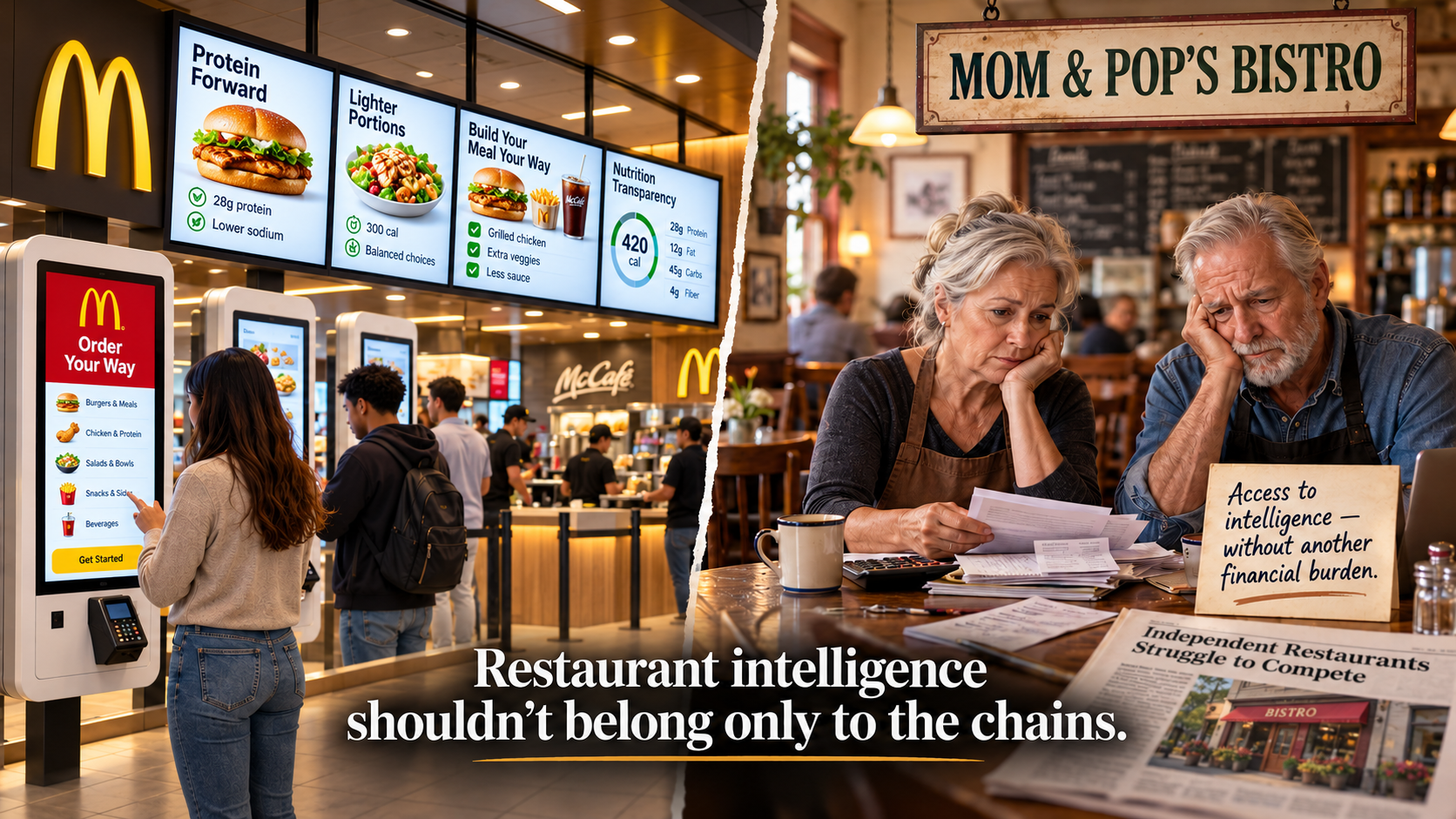
As GLP-1s and changing consumer habits reshape how people order food, independent restaurants deserve access to the same kind of intelligence as the largest chains.
A couple of weeks ago, I went to Reddit with a question for small restaurant owners.
I had been thinking about GLP-1s from the restaurant side instead of the patient side. People taking these medications are still eating out, but many are approaching food differently: smaller portions may make more sense, protein matters more, and an entrée that once felt normal may suddenly feel like two meals.
So I asked what would help restaurants adapt. Better nutrition information? Smaller portions? Easier substitutions? A few menu options that work better for this changing customer?
One response was basically honest & firm: “You want little mom-and-pop restaurants to provide nutrition information? GTFOH.”
And in a strange way, I thought: Exactly.
Because the last thing I want is another requirement placed on independent restaurants.
Small operators are already dealing with food costs, labor, rent, insurance, delivery platforms, credit-card fees and customers who still expect value. Restaurant margins are thin enough that the National Restaurant Association reported 42% of operators were not profitable in 2025. NRA
My question was never, how do we make small restaurants pay for another thing?
It was: how do we make sure they don’t have to?
That question became even more interesting last week when McDonald’s announced its McDonald’s > NEXT strategy. The company plans to provide approximately $8.5 billion in support through 2036 for restaurant modernization, technology and operational improvements. To be clear, that $8.5 billion is not a dedicated GLP-1 investment. But at the same time, McDonald’s is openly preparing its menu for changing consumer behavior, including customers looking for smaller portions and more protein-focused options. News Release Archive
That caught my attention because McDonald’s is seeing something we have been thinking about at DrunR for a while: the future diner may not stop eating out. They may simply eat out differently.
Circana's research supports that. GLP-1 users continue visiting restaurants, but what they order is changing. They are showing greater interest in smaller portions and different food choices, while the broader market is moving in a similar direction. Thirty-five percent of restaurant consumers reported ordering smaller portions for health reasons, and nearly half of U.S. adults are now seeking more protein in their diets. Among GLP-1 users, that rises to 65%. Circana
That is why I don't think restaurants should rush to create a section called “GLP-1 Menu.”
This is bigger than one medication.
Tomorrow's diner may simply define value differently. They may want a smaller portion instead of the largest plate possible. They may care about protein, fiber and ingredients. They may want sauce on the side, a different preparation, or enough information to understand what they are ordering before the meal arrives.
And many restaurants may already have dishes that fit those needs.
The problem is that the customer may not know it, and the restaurant may not have the data or resources to see it either. McDonald's has research teams, transaction data, technology, nutrition expertise and billions of dollars available to respond to changing behavior.
The independent Thai restaurant down the street does not. Neither does the family-owned Mexican restaurant, the neighborhood café or the small restaurant operating on a few points of margin.
That is the gap I think technology should help close.
DrunR originally approached restaurant menus from the diner side. We are working on turning ordinary menu information into structured estimated nutrition intelligence, particularly when official nutrition information is unavailable, so people can make more informed decisions before ordering.
But the more we work on menus, the more obvious the restaurant-side opportunity becomes.
The same intelligence could help an owner look at an existing menu and ask a very different question: How well does what I already serve match the way customers are beginning to eat?
Maybe the restaurant doesn't need ten new dishes.
Maybe three current dishes are already strong options and simply need to be easier to identify.
Maybe one entrée could offer a smaller portion. Maybe another works with a simple preparation change. Maybe diners would value knowing that one existing meal is more protein-forward than another.
That is very different from asking a small business to rebuild its kitchen around a trend.
And for independent restaurants, our intention with DrunR is to make this kind of support available without charging them for it.
We want to be able to work from the menu they already have, surface estimated nutrition information where appropriate, identify practical opportunities and, just as importantly, learn from the owner about what is realistic inside their kitchen. Our existing restaurant-outreach direction has been built around free estimated nutrition support, no required operational changes and minimal onboarding burden.
There is a benefit to DrunR too. Better restaurant information improves what we can offer diners, while working directly with restaurant owners helps us understand the operational reality behind a menu instead of viewing food only as data.
That feels like a much healthier model: help both sides understand each other better.
The diner gets more clarity.The restaurant gets better insight into where its customer may be heading.
And the small operator does not need the research department of a global corporation to participate.Which brings me back to that Reddit comment.
Do I want little mom-and-pop restaurants to suddenly become nutrition laboratories?
No.
I want us to build the technology so they don't have to.
McDonald's can spend billions preparing for the future diner. The restaurant down the street should have a way to prepare for that same future without burning through an already tight budget. And if technology is going to change the restaurant industry, I think that is one of the places it can actually make the playing field a little more even.