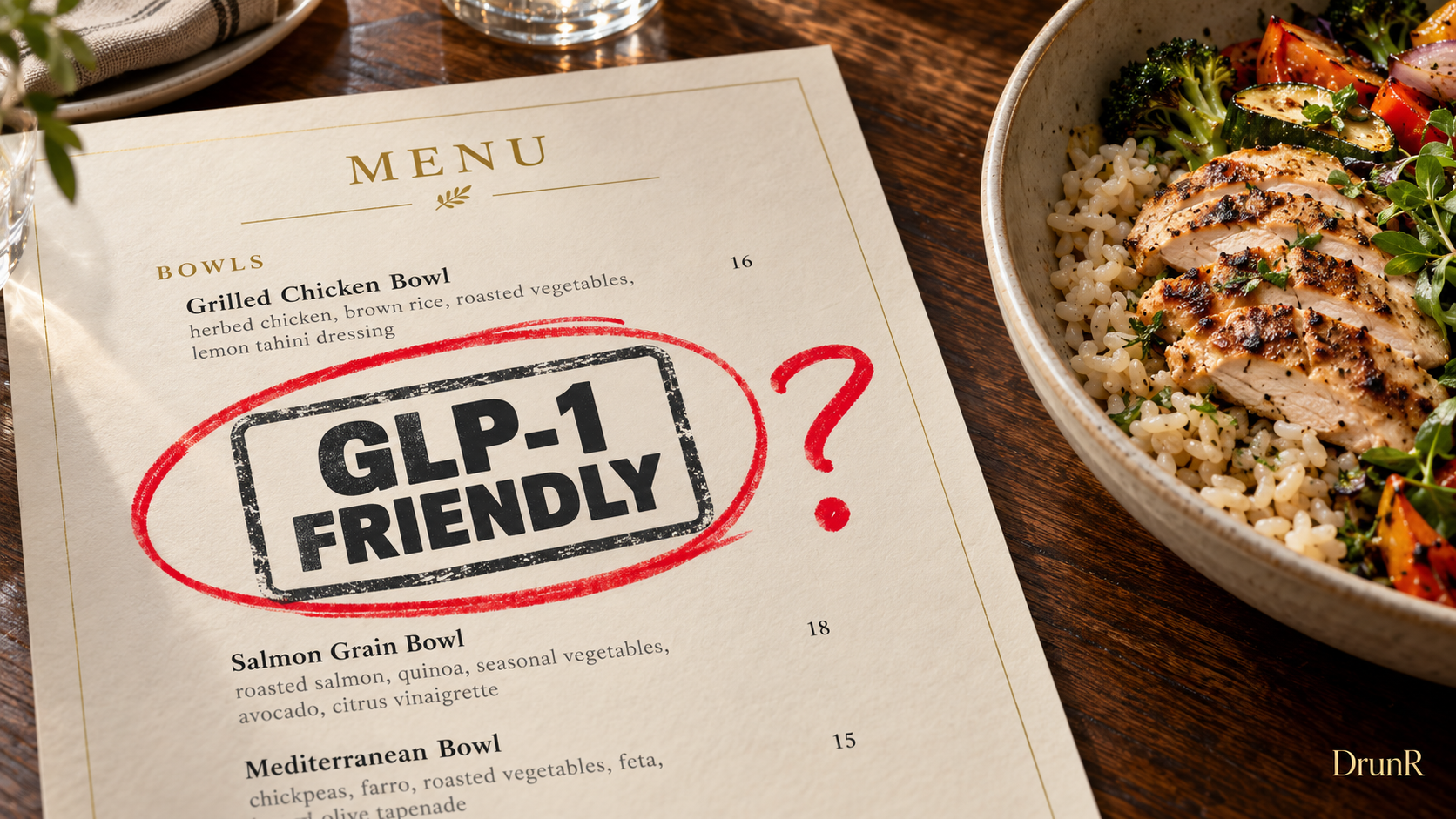
A meal can be “GLP-1 friendly” and still not be the right meal for you today.
That does not make the label useless. It means the label answers only one part of the question: What is generally true about this food?
Protein, fiber, portion size, preparation, added sugar, saturated fat, and sodium can help describe whether a meal broadly aligns with common nutrition priorities for people using GLP-1 medications. Current professional guidance also emphasizes overall nutrition quality, adequate protein and fluids, and attention to gastrointestinal tolerance during treatment. Diabetes Journals
But none of that tells us enough about the person who is about to eat the meal.
Appetite can be normal one day and much lower the next. Nausea, constipation, vomiting, abdominal discomfort, and other gastrointestinal symptoms are among the reactions reported with GLP-1 medicines, and their presence and intensity can vary across people and over time. U.S. Food and Drug Administration
Recent meals matter too. So do activity, recovery, hydration, symptoms, and what the person has been able to tolerate lately.
The food may stay the same.
The fit may not.
This is the limitation of treating “GLP-1 friendly” as a final answer. It turns a changing relationship between a person and a meal into a permanent label attached to the food.
A better model separates two questions.
First: What is generally true about this meal?
Second: How well does this meal fit this person today?
Consider a Grilled Salmon Bowl. Its food-level qualities do not change simply because a different person opens the menu. The salmon still provides protein. The rice, sauce, portion, preparation, fiber, and sodium remain properties of the meal.
Now imagine the same patient considering that bowl twice in one week.
On Monday, they slept well, have a normal appetite, report no current symptoms, and have room for a full meal. The bowl as served may be a strong fit.
On Thursday, their diagnosis, medication context, goals, and preferences are essentially unchanged. The salmon bowl has not changed either. But their appetite is lower, they slept poorly, and mild nausea is present.
The meal has not suddenly become “bad,” and the patient has not become a different person. What changed is the relationship between that meal and the person at that moment.
The better guidance may therefore be the same bowl with a smaller portion, less rice, or sauce on the side. On another day, perhaps after more activity or with a meaningful protein gap, the full bowl may fit better.
Same patient. Same meal. Different day. Different fit.
This distinction is built into how we are designing DrunR.
Our current intelligence model separates the food-level assessment from the personal match. The same menu item, with the same nutrition and portion evidence, keeps the same food-level evaluation regardless of the user’s sleep, activity, medication context, CGM data, or current state.
Only after that does the system ask how the meal fits the person’s current context. The architecture distinguishes the food’s general qualities, the user’s current multimodal state, and the final recommendation rather than collapsing all three into one static “friendly” label.
That separation matters because a generally strong food can still conflict with an active need.
A high-protein meal is not automatically the right choice if its portion, fat content, or preparation does not fit the person’s current tolerance. In DrunR’s current model, a GI-sensitive state can shift preference toward smaller portions and gentler preparation without declaring the original food universally unhealthy. The model also avoids automatically selecting the highest-protein item when it conflicts with another active state.
This is also why restaurants may not need a separate section labeled “GLP-1 Menu.”
They may create more value by offering flexibility: clear portion options, sauces on the side, simple ingredient swaps, preparation choices, and enough information for a diner to understand the trade-offs.
A fixed menu label says, “This meal works for GLP-1 users.”
A more honest experience says, “Here is what is generally true about this meal, and here are ways it might be adapted to what you need today.”
That is a less convenient answer, but it is closer to how people actually live.
“GLP-1 friendly” can still be useful as an entry point. It can help narrow a menu and surface meals that broadly support common nutrition priorities.
It just should not be mistaken for personalization.
A static label belongs to the food.
A personal recommendation belongs to the relationship between the food, the person, and the moment.
That is why the question we want DrunR to answer is not simply:
Is this meal GLP-1 friendly?
It is:
Given what we know about this meal and what appears to matter for this person right now, how well do they fit together?
Because there is no single meal that is right for every GLP-1 user on every day.
Sometimes the meal should change.
Sometimes only the portion or preparation should change.
And sometimes the food is exactly the same, but the day is different.